


If you move between cash and Bitcoin often, a Bitcoin ATM can be a quick bridge from traditional finance to crypto. If you want a safe pick that emphasizes privacy and low costs, this guide highlights leading low-fee Bitcoin ATM options and where they shine.
What Are the Top Bitcoin ATMs?
1. ATM
Availability: Europe and Peru.
Crypto Supported: BTC, ETH, and 4+ assets.
KYC: Low.
Fees: Typically 3%–4%, but varies by market. This is among the lowest advertised fee ranges you’ll see from major Bitcoin ATM operators, especially compared with kiosks that commonly price closer to high single digits or the low double digits once all-in costs are accounted for.
Overview
emphasizes transaction privacy, requesting identification only where laws demand it. The operator periodically runs promotions that drop fees to 0% or add a bonus to exchange rates. Nearly 200 machines operate across Europe and Peru, with further growth planned.
Pros and Cons
Pros:
- Low average fees for buying and selling.
- Minimal or no identity checks, subject to local rules.
Cons:
- Service area limited to Europe and Peru.
More Details
Pricing differs by jurisdiction: buy and sell rates may swap favorability depending on country. The network supports six coins (BTC, ETH, LTC, USDT, TRX, DASH), each with its own dynamic rates.
2. Coinstar Bitcoin Machines

Availability: U.S.
Crypto Supported: BTC, LINK, and 6+ assets.
KYC: Intermediate.
Fees: About 4% plus up to 11% cash exchange fee. For a typical transaction, the effective total can land roughly in a 4% to 15% range depending on the kiosk and the cash exchange portion.
Overview
Coinstar adapted thousands of coin-counting kiosks to enable Bitcoin purchases, making crypto accessible in more than 9,500 U.S. locations across 49 states. Through its partnership model, customers can buy Bitcoin conveniently while shopping.
Pros and Cons
Pros:
- Located in everyday grocery stores for easy access.
- Fees range from low to mid-tier compared with peers.
Cons:
- Kiosks accept bills only for crypto purchases.
- Available only in the United States.
More Details
Expect a ~4% transaction fee plus up to 11% for cash exchange, depending on location. On a $100 purchase, that’s roughly $4 to $15 in fees in many cases, before any other bank or card-related charges outside the kiosk’s pricing. Supported tokens include BTC, LINK, DOGE, ETH, LTC, MATIC, XLM, and USDC.
3. Just Cash ATM

Availability: U.S.
Crypto Supported: BTC.
KYC: Low.
Fees: Low (structure not fully disclosed). Because the full schedule isn’t published at the terminal level, the “all-in” cost is best thought of as variable; in practice, it’s often described as competitive with lower-cost ATM options, but it can still end up closer to other U.S. kiosks depending on the machine and route used.
Overview
Operating since 2015 in Florida, Just Cash enables Bitcoin purchases through conventional ATMs by leveraging existing banking rails to bring crypto to familiar machines.
Pros and Cons
Pros:
- No identity verification required at the terminal.
- Built on the established ATM network and payment flows.
- Issues paper wallets for custody convenience.
Cons:
- Fee transparency could be better.
- Available only within the United States.
More Details
Beyond a debit card and PIN, no extra checks occur at the machine. Users can also tap cardless ATM networks. After purchase, a receipt and a paper wallet containing public and private keys are provided.
4. LibertyX ATM
Availability: U.S.
Crypto Supported: BTC.
KYC: Intermediate.
Fees: Around 8%. This is generally treated as the kiosk’s quoted pricing/markup for the purchase, while other costs (such as wallet network fees) can still apply depending on how the transaction is finalized. Relative to many Bitcoin ATMs that land in the low double digits, ~8% can be competitive.
Overview
Launched in 2013 with one of the first anonymous Bitcoin ATMs, LibertyX now powers purchases at major retailers like CVS, Walgreens, Rite Aid, and Costco using the same dependable cash machines—no bank linking or wire transfers required, just a debit card and the app.
Pros and Cons
Pros:
- Broad retail presence in well-known chains.
- Companion mobile app for discovery and setup.
Cons:
- Service limited to the U.S.
- Tiered verification applies for higher limits.
More Details
LibertyX is non-custodial and works with mobile, desktop, and hardware wallets. Enter your address in the app, begin the purchase at an ATM with your debit card, and finalize at 30,000+ locations; some stores also accept cash.
5. RockitCoin

Availability: U.S. and Puerto Rico.
Crypto Supported: BTC, BCH, LTC, ETH.
KYC: Low.
Fees: Spread plus a flat $1–$2. On smaller buys, the flat $1–$2 can add roughly 1%–2% on a $100 purchase, with the remaining cost driven by the quoted rate/spread. For example, if the spread works out to 6%–10% at a given machine, a $100 buy could land around $7–$12 in total fees ($6–$10 via spread plus $1–$2 flat).
Overview
Headquartered in Chicago, RockitCoin operates 1,500+ ATMs across U.S. cities and towns. Beyond kiosks, it offers a mobile wallet and an online exchange, and it allows community hosting of ATMs for added income.
Pros and Cons
Pros:
- Light-touch verification requirements.
- 24/7 machine availability in most locations.
- Higher-than-average withdrawal ceilings.
Cons:
- Coverage restricted to the U.S. and Puerto Rico.
More Details
Instead of an ID scan, a phone number is typically requested. The RockitCoin app enables buying, selling, transferring, and storing a range of coins while giving users sole control of their private keys.
6. Pelicoin ATM

Availability: Southern U.S.
Crypto Supported: BTC, LTC, ETH.
KYC: Intermediate.
Fees: Not disclosed. With the schedule not consistently posted in a single place, users should assume pricing can vary by machine and state; as a rough expectation, regional operators often fall into the high single digits to low double digits, which can place them above the very lowest-fee promos but in line with many everyday kiosks.
Overview
Pelicoin focuses on the Gulf South, with machines across Texas, Louisiana, Mississippi, and Alabama—often in late-night or 24-hour stores. Purchases can go directly to a wallet or be printed as a paper wallet.
Pros and Cons
Pros:
- Paper wallet option for quick self-custody.
- Operator absorbs certain ATM fees in eligible cases.
Cons:
- Footprint limited to select Southern states.
- Pricing details are not always clear.
More Details
Most transactions require only a phone and cash; a driver’s license may be needed at higher tiers. The network supports BTC, LTC, and ETH, and you can receive funds via QR code, standard wallet, or paper wallet.
What Are Bitcoin ATMs?
Bitcoin ATMs resemble cash machines but operate with cryptocurrency. They let you withdraw cash or buy and sell crypto, and some support sending coins. Unlike bank-linked ATMs, these kiosks connect to crypto services rather than checking accounts.
They pull from crypto wallets, compatible debit cards, or exchange-linked accounts. Typical steps: scan a QR code or enter a wallet address, choose an amount, and complete the transaction; the machine converts between fiat and BTC in your local currency.
As with any in-person crypto purchase, key risks can include paying more than you expected due to pricing differences, scams or social engineering near kiosks, sending funds to the wrong address, privacy tradeoffs when verification is triggered, and limited recourse once a transaction is finalized.
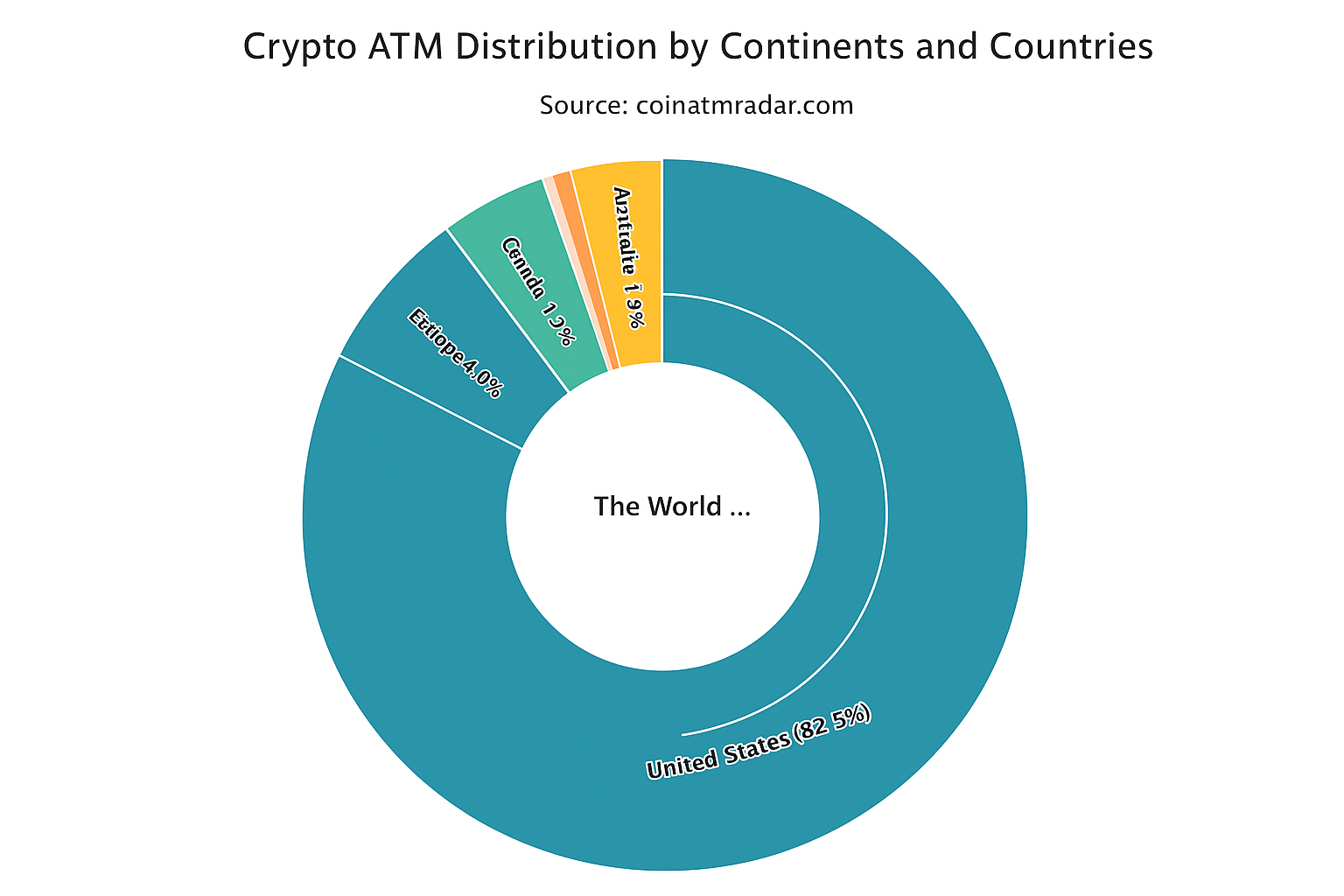
With tens of thousands of kiosks worldwide and growing, everyday uses—from buying groceries with crypto to instant cashing out—are becoming routine. In emergencies, rapid crypto-to-cash access has even helped refugees obtain funds.
Bitcoin ATM Comparison
| ATM Operator | Availability | Supported Cryptos | KYC Level | Fees |
|---|---|---|---|---|
| Europe and Peru | BTC, ETH, and 4+ | Low | Typically 3%–4% | |
| Coinstar Bitcoin Machines | U.S. | BTC, LINK, and 6+ | Intermediate | 4% plus up to 11% cash exchange |
| Just Cash | U.S. | BTC | Low | Low (not fully disclosed) |
| LibertyX | U.S. | BTC | Intermediate | About 8% |
| RockitCoin | U.S. and Puerto Rico | BTC, BCH, LTC, ETH | Low | Spread plus $1–$2 flat |
| Pelicoin | Southern U.S. | BTC, LTC, ETH | Intermediate | N/A |
What Is a Bitcoin ATM?
A Bitcoin ATM is an internet-connected kiosk that lets you buy or sell Bitcoin using cash or a debit card. You typically scan a wallet QR code to receive BTC or enter wallet details to sell and collect cash—no bank account required.
These machines settle on the blockchain, offering a practical on-ramp or off-ramp to cryptocurrency for people who prefer cash-based or bankless access.
Low Fees and Privacy: You Can Have Both
- Compliance and regulatory costs.
- Cash logistics and armored transport.
- Connectivity and maintenance expenses.
- Operator profit margins.
- Location fees.
As competition and scale improved, many providers trimmed margins and streamlined KYC. Today, you can find crypto ATMs with lower fees that still protect user privacy within legal bounds.
Whether they’re “worth it” depends on what you’re optimizing for: ATMs can be faster and more convenient for cash users, and they can be simpler when you don’t want to link a bank account, while exchanges often win on raw pricing when you can wait and use bank transfers.
If you’re trying to minimize what you pay at a kiosk, focus on the total price shown on-screen before confirming, look for operator promotions, avoid very small purchases where flat charges matter most, and compare multiple nearby machines since pricing can vary significantly by location.
Bitcoin ATMs quote a retail, all-in price for immediate access, while exchanges typically charge smaller trading fees and let users optimize timing, funding method, and execution.
Frequently Asked Questions
What’s the Difference Between a Bitcoin ATM and a Regular ATM?
A Bitcoin ATM enables buying and selling crypto with cash or a debit card, while a standard ATM connects to bank accounts for deposits and withdrawals. Crypto kiosks require a wallet address or QR code, whereas bank ATMs rely on your bank card and PIN.
Is LibertyX an Actual Bitcoin ATM?
Yes. LibertyX operates a large U.S. network that lets customers purchase Bitcoin with cash or a debit card, often inside major retail chains, supported by a companion app.
What Fees Do Crypto ATMs Charge?
Fees vary by operator and location, but many Bitcoin ATMs land in the high single digits to the mid-teens when you look at the effective “all-in” difference versus spot pricing. Common components include the operator’s quoted buy/sell price versus spot, any on-screen service charges, and (depending on the setup) additional payment-processing or conversion charges.
Compared with exchanges, the gap is usually noticeable: many major exchanges charge trading fees that can be well under 1% for liquid markets, plus a separate BTC withdrawal fee that depends on the platform and network conditions.
How Do Crypto ATMs Process Transactions?
Some machines use app-generated QR codes; others debit an exchange account, a linked wallet, or a compatible card. Certain models can also print paper wallets to complete delivery.
Which Bitcoin ATMs Have the Lowest Fees?
Costs differ widely, but the lowest-fee experiences tend to come from operators that run promotions or post consistently tight pricing in specific markets. When is in its typical 3%–4% range (or running a promo), it can undercut many kiosks that price in the low double digits.
Do Bitcoin ATMs Charge a Fee?
Yes. Most include a spread and service charges that can add up to a meaningful total percentage, plus any applicable flat or conversion fees.
How Much Does a Bitcoin ATM Charge for $100?
If a kiosk charges 15%, a $100 purchase incurs about $15 in fees, excluding any additional flat or currency conversion charges. At lower-fee pricing like 3%–4%, that same $100 purchase is roughly $3–$4 in fees, assuming the operator’s displayed price reflects the full cost of the transaction.
What Are the Best Bitcoin ATMs?
- Low fees.
- Light-touch KYC.
- Broad availability.
and Coin Cloud are frequently cited for competitive pricing and reach.
Who Operates the Most Bitcoin ATMs?
LibertyX holds a leading share in the U.S., with Coinme following. The United States hosts the largest national footprint of Bitcoin ATMs.
Who Makes Bitcoin ATMs?
The ecosystem includes hardware manufacturers, software providers, and retailer-operated networks. Notable names include LibertyX, Bitcoin Depot, and Coinme.
What Is a Bitcoin ATM?
It’s a connected kiosk for buying and selling Bitcoin with cash or debit. You scan a wallet QR code to receive BTC or enter wallet data to sell and withdraw cash—no bank account needed.
Are Bitcoin ATMs Anonymous?
Some allow smaller purchases without identity checks, but larger or suspicious activity typically triggers KYC requirements under local regulations.
Are Bitcoin ATMs Private?
Providers may retain limited transaction data to satisfy legal obligations and then purge it after mandated retention periods. Review each operator’s terms for specifics.
Which Exchange Has the Lowest Bitcoin Withdrawal Fee?
Withdrawal fees change often and can be fixed or dynamic, so the “lowest” depends on the exchange’s current schedule and how congested the Bitcoin network is. Among major exchanges, the lowest posted BTC withdrawal fees are often found on platforms that batch withdrawals and keep a relatively small fixed fee (or a tight dynamic fee).
As a rough reference, you’ll commonly see ranges such as:
Binance: often around 0.00002 BTC for a standard BTC withdrawal tier (varies by network and settings).
Kraken: commonly in the 0.00001–0.00005 BTC range depending on the withdrawal method/network conditions.
Coinbase: often variable, frequently landing somewhere in the 0.00005–0.0002 BTC range depending on timing and network conditions.